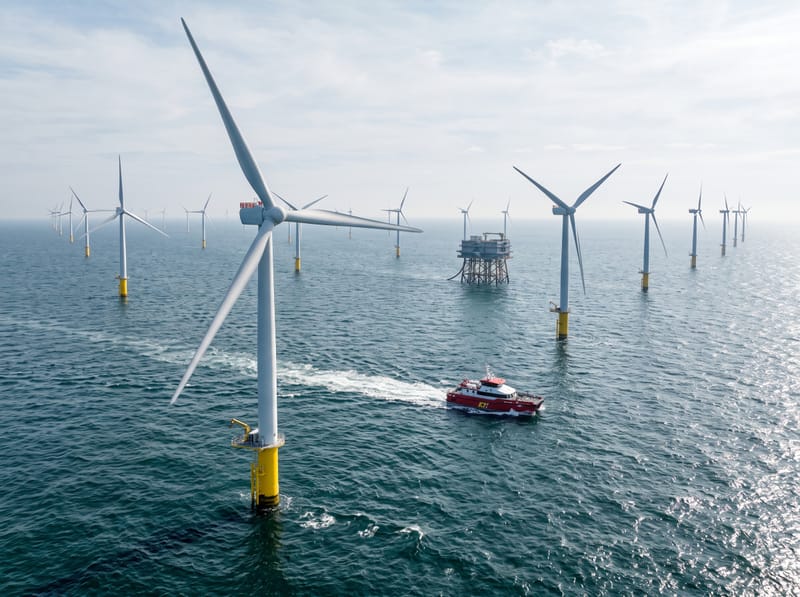
How Do Wind Turbines Work? From Blade to Grid
How do wind turbines work? Blades, generator, the Betz limit and a worked example showing why power rises with the cube of wind speed.
• A wind turbine is a rotor that harvests kinetic energy, a generator that makes electricity, and a controller that keeps both inside safe limits.
• No turbine can capture more than 16/27 (about 59.3%) of the wind's kinetic energy. That is the Betz limit. Good machines reach roughly 45–50% in the useful part of their curve.
• Below rated wind speed, power rises with the cube of wind speed. From 8 m/s to 10 m/s is almost twice the power, not 25% more.
• Above rated speed the blades pitch to spill wind, so the cube law stops and power stays near the nameplate until the turbine shuts down in a storm.
How do wind turbines work? Wind is moving air, and moving air carries kinetic energy. The blades are shaped so the air pushes them sideways as it passes, the hub turns a shaft, and a generator converts that rotation into electrical current. Everything else in the nacelle — brakes, gearbox or the lack of one, converter, transformer, yaw motors — exists to make that conversion efficient and to stop it when the weather, or the grid, says stop.
How do wind turbines work?
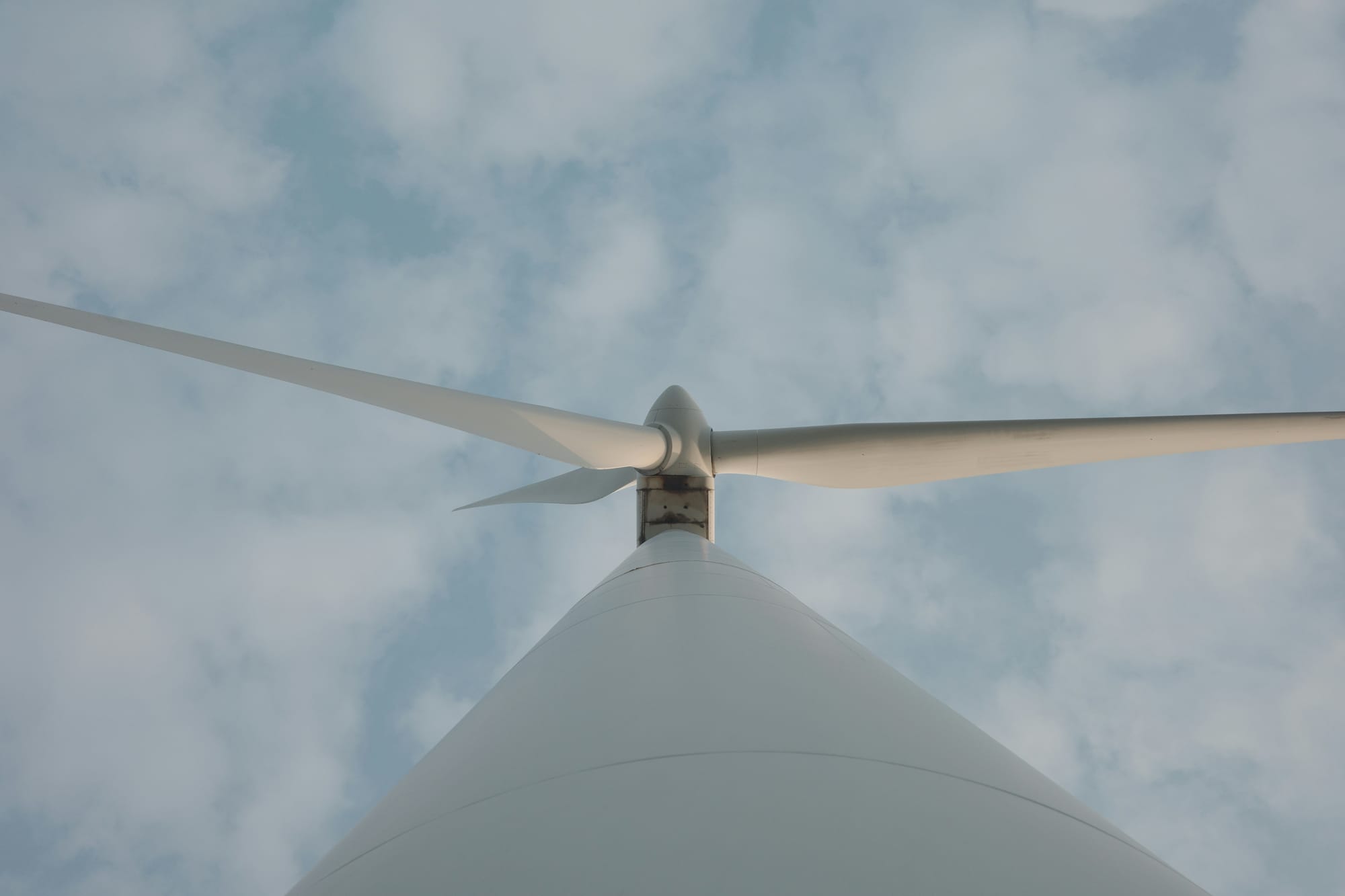
Stand upwind of a modern turbine and you are looking at three blades on a horizontal axis. This is the layout of almost every large machine built in the last two decades, on land and at sea. Vertical-axis designs exist and show up in small products. They are not what feeds the grid at scale.
Each blade is an aerofoil, the same idea as an aircraft wing. Air moves faster over one face than the other, pressure differs, and the net force has a component that pulls the blade around the hub. The blade is also twisted along its length, because the tip moves much faster than the root and the angle that makes lift has to change. The rotor sweeps a disk. A 100 m diameter sweeps about 7,850 m². A 236 m offshore rotor, such as Vestas's V236-15.0 MW, sweeps several times that. Power starts with area, because you can only harvest the air that actually passes through the disk.
The US Department of Energy's primer splits the machine into the rotor, the nacelle and the tower. The rotor catches the wind. The nacelle holds the drivetrain and the controls. The tower holds the disk up where the wind is stronger and smoother than it is near the ground. Sensors on the nacelle measure speed and direction. Yaw motors turn the whole head to face the wind. Pitch motors twist each blade. A controller does both many times a minute.
How does a wind turbine work, from blade to wire?
How does a wind turbine work once the shaft is turning? There are two common drivetrains. A geared machine steps the slow rotor (often 5–15 revolutions per minute on a large turbine) up to a few hundred or a few thousand revolutions, which suits a compact generator. A direct-drive machine uses a large, slow generator and skips the gearbox. Both feed a converter that turns variable-frequency electricity into something the grid can accept: a steady frequency and voltage. A transformer at the base of the tower, or in the nacelle on some offshore machines, steps the voltage up for the cables.
| Part | Job |
|---|---|
| Blades and hub | Turn the pressure of moving air into torque. |
| Pitch system | Twists the blades to limit power and to feather them in a fault. |
| Main shaft, gearbox or direct drive | Carries torque to the generator at the right speed. |
| Generator and converter | Make electricity and match it to grid frequency. |
| Yaw system | Points the nacelle into the wind. |
| Tower and foundation | Hold the disk up, and carry the load into the ground or the seabed. |
| Controller, brakes, anemometer | Start, stop, and ride through faults without overspeeding. |
The turbine does not run in every breeze. A typical large machine starts producing around 3–4 m/s (the cut-in), reaches its nameplate power around 11–13 m/s (rated speed), and shuts down to protect itself somewhere near 25 m/s (cut-out). Those are typical brochure ranges, not a law. [CHECK the cut-in, rated and cut-out speeds on the turbine you are actually reading about.] Between cut-in and rated speed the controller tries to hold the rotor at its most efficient tip-speed ratio. Above rated speed it gives up on efficiency and pitches the blades so power stays flat. In a storm it feathers the blades and waits.
The Betz limit, and why 100% is impossible
In 1919 Albert Betz showed that a rotor in open flow cannot take all the kinetic energy out of the wind. If it did, the air would stop in the disk and no more air could arrive. The maximum fraction is 16/27, or 59.3%. That fraction is called the power coefficient, Cp. The Betz limit is Cp = 0.593. Real rotors also lose energy to drag and to the wake of the blade itself. A well-designed utility turbine reaches a peak Cp of roughly 0.45–0.50 in clean wind. [CHECK a specific Cp curve before you quote it for a named model; manufacturers do not all publish one.]
The power in the wind through a disk, before the turbine takes its share, is:
P = ½ × ρ × A × v³
ρ is air density, about 1.225 kg/m³ at sea level and 15°C. A is the swept area. v is the wind speed. The turbine's electrical output is that quantity times Cp, times further losses in the gearbox, generator and converter. Hot air and high altitude lower ρ, so the same wind speed makes less power in the desert at elevation than on a cold coast.
A worked example: 8 m/s versus 10 m/s
Take an illustration, not a product: a 100 m rotor, Cp = 0.45, sea-level density, and no other losses. Area = π × 50² = 7,854 m².
| Wind speed | v³ | Power at Cp 0.45 |
|---|---|---|
| 8 m/s | 512 | ½ × 1.225 × 7,854 × 512 × 0.45 ≈ 1.11 MW |
| 10 m/s | 1,000 | ½ × 1.225 × 7,854 × 1,000 × 0.45 ≈ 2.16 MW |
| 16 m/s, if Cp stayed 0.45 | 4,096 | Eight times the 8 m/s case, about 8.9 MW. A real controller will not allow this. |
From 8 to 10 m/s the speed rose 25%. The power rose by (10/8)³ = 1.95, almost a doubling. That is the fact operators care about: a slightly windier site is a much more productive site. It is also why one calm week shows up so clearly in a wind farm's output. Doubling the speed, from 8 to 16 m/s, would multiply power by eight if the blades kept the same Cp. They do not. By 16 m/s a turbine rated at 3 MW has been pitching for a long time, and output sits near 3 MW, not 9 MW. The cube law is the physics of the wind. The flat top of the power curve is the engineering choice that keeps the generator, the gearbox and the tower from being built for a storm they only see a few hours a year.
Nameplate power is not annual energy. If a 3 MW turbine averaged 1 MW over the year, its capacity factor would be 1/3, about 33%. Energy is average power times hours. IRENA's cost report for projects commissioned in 2024 notes that the global average cost of onshore wind moved partly because capacity factors in important markets were lower that year. The machine can be excellent and the year can still be less windy.
Real: a tall tower and a large swept area, in a measured wind resource, make cheap electricity. IRENA's 2024 global average for new onshore wind was $0.034/kWh.
Hype: a small turbine on a suburban roof. Wind speed is low and turbulent near houses, area is tiny, and the cube law works against you. Half the wind speed is one eighth of the power.
Verdict: utility turbines work because the disk is huge and the site was chosen with a wind study. A roof needs that study before anyone talks about payback.
Frequently asked questions
How do wind turbines work when the wind changes direction?
Sensors measure direction and yaw motors rotate the nacelle until the rotor faces the wind. They do not chase every gust. Chasing would fatigue the tower.
How does a wind turbine work without a gearbox?
Direct-drive machines use a generator with many poles, built to produce electricity at the rotor's slow speed. There is less mechanical gearing, and a heavier generator. Both layouts are in commercial use.
Why do turbines have three blades, not two or five?
Three blades balance efficiency, cost, visual speed and the loads on the hub. Two blades are cheaper and noisier in rotation. More than three adds cost faster than it adds energy. The choice is a compromise, which is why research machines sometimes look different.
Do turbines use power from the grid?
Yes, in small amounts: yaw motors, pitch motors, lights, heaters and controls. During production the turbine supplies far more than those loads. In a dead calm it draws a little power so it is ready to start.
Why do they stop in high wind?
Loads on the blades and tower rise quickly, and the energy above rated speed is not worth the extra steel. Cut-out, often near 25 m/s, is a design limit. [CHECK the manual.] The blades feather, the rotor brakes or coasts, and the machine waits for a calmer hour.
How much of the wind's energy do they actually take?
At the rotor, a peak of roughly 45–50% is a good result, against a ceiling of 59.3%. After the generator and the converter, the share of the wind's kinetic energy that becomes electricity is lower still. The rest remains in the slower wind behind the turbine, which is why the next row of turbines is spaced many rotor diameters away.
Want to see real projects on a map? Our project atlas includes onshore and offshore wind alongside solar and storage. The megawatt labels are a guide; confirm them on the operator's page before you cite them. For a roof, wind is rarely the right tool — the solar calculators are.