Tesla Flying Car: How the 2026 Roadster Really Works
Is the Tesla flying car real? An engineer explains the 2026 Roadster demo: specs, 0-60, price, release date, and why it hops instead of flying.
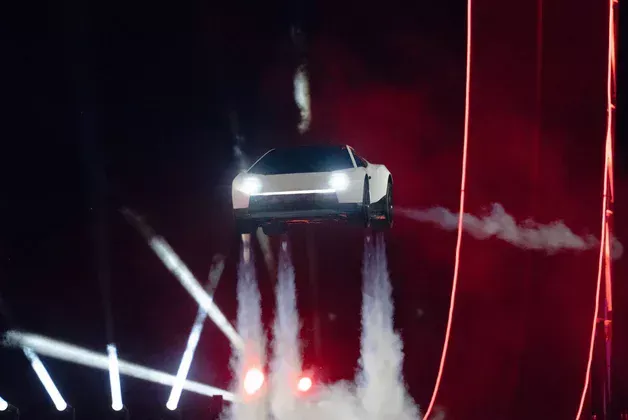
• On 15 October 2026 Tesla showed a Roadster prototype that drove upside down on a ramp, launched into the air, flipped over a row of Teslas and landed on its wheels. No one was inside.
• The tricks come from two systems: a fan that sucks the car onto the road, and cold-gas thrusters fed by up to 600 litres of compressed air.
• Compressed air can only lift a car for a few seconds. That is why experts call it "hopping", not flying.
Is the Tesla flying car real? Nine years after it was first announced, Tesla finally showed its next-generation Roadster. The headline was not the range or the price. It was a car that left the ground. Elon Musk told the crowd that "flying cars are real". An aviation expert told CNN it was "closer to hopping". Both statements describe the same few seconds of video, so let's look at what actually happened and at the engineering behind it.
The Tesla flying car demo: what actually happened
The Roadster was unveiled on the night of 15 October 2026 at a SpaceX test site in Texas (reports name it as Waco or nearby McGregor) and livestreamed on Tesla's X account. The reveal had been delayed by weather at the site.
In the main demo, the car:
- drove up a curved ramp until it was hanging upside down, held in place by a fan under the car;
- launched off the end of the ramp, rolled 180 degrees in the air and cleared a row of parked Teslas (Model 3, Model Y, Cybertruck, Semi and Cybercab);
- landed on its wheels. Tesla's engineering VP Lars Moravy called the move a "kickflip".
The car had no driver. Musk said this was deliberate, "to make sure we don't kill anyone" if the manoeuvre went wrong. He also said the car's "success is not guaranteed", but "it will probably work".
Tesla Roadster 2026: specs, 0-60, price and release date
Tesla presented three trims of the new Tesla Roadster. Only the top one has the full thruster system, which many fans call the "SpaceX package".
| Trim | Seats | Key hardware | Claimed 0–60 mph | Availability |
|---|---|---|---|---|
| Performance | 2 | Active aero, fan suction | under 1.6 s | Reservation ($50,000) |
| Thrust | 2 | Adds rear cold-gas thrusters, about 200 L of air | under 0.9 s | Limited ($250,000 reservation) |
| Rocket | 1 | Thrusters around the body, about 600 L of air, 10 thrusters | under 0.59 s | Invite only, not approved for public roads |
Tesla also claims more than 230 mph (370 km/h) top speed and over 300 miles (480 km) of range for all three. In the live run, Tesla said the car reached 60 mph in 0.81 seconds after some trouble with the timer. No final price has been announced, and Musk says production starts in 2028.
Trick 1: a fan that glues the car to the road
Normal sports cars use wings to push the car down at high speed. Downforce from a wing depends on speed, so it does nothing when the car is slow. A suction fan is different: it pulls air out from under the car and lowers the pressure there, so the outside air pushes the car down even when it is barely moving. Moravy compared it to a McMurtry-style fan, the system that let the McMurtry Spéirling hypercar drive upside down in 2024.
Tesla says its fan can pull up to 2 g. That is enough to hold the car to the ceiling of a ramp, as long as the seals under the car stay close to the surface. The same idea helps cornering and braking on the road, which is the real performance benefit for the Performance trim.
Trick 2: cold-gas thrusters, the "SpaceX package"
The Thrust and Rocket trims add cold-gas thrusters. There is no combustion. Air is stored at very high pressure, around 10,000 psi (about 690 bar), in tanks behind the seats. When a valve opens, the air rushes out through a nozzle and pushes the car the other way. Spacecraft use the same principle for small attitude corrections, which is where the SpaceX link comes from. Tesla says the car refills its own tanks with an onboard compressor.
The Rocket trim uses 10 thrusters fed by about 600 litres of air. Rear thrusters push the car forward for the sub-second launch. Thrusters around the body control roll and pitch in the air, which is how the car rotated and landed on its wheels.
Can the Tesla Roadster really fly? A quick calculation
This is the part most coverage skips. To hover, thrust must equal the car's weight. Here is a back-of-the-envelope estimate with stated assumptions, because Tesla has not published the car's mass or thruster data.
| Assumption | Value used |
|---|---|
| Car mass | about 1,800–2,000 kg (typical for a fast EV with a big battery) |
| Thrust needed to hover | mass × 9.81 ≈ 18–20 kN |
| Efficiency of a compressed-air thruster (specific impulse) | about 50–70 s, typical for cold-gas systems |
| Air on board (600 L at about 690 bar) | roughly 200–260 kg, if all of it were usable |
Air used per second = thrust ÷ (specific impulse × 9.81). That gives roughly 26–40 kg of air every second. A full tank would therefore hold the car up for only about 5 to 10 seconds, and in practice less, because tank pressure falls as it empties.
So the physics agrees with the expert: the system can launch, rotate and soften a landing, but it cannot sustain flight. Real flying cars use propellers driven by electric motors, which push a large mass of air slowly and are far more efficient for hovering.
There is also a cost. Electrek pointed out that tanks, valves and thrusters add mass and complexity, and more mass means less acceleration from the same motors (Newton's second law). Its verdict was that the jumping is "a party trick" that will not help normal driving performance.
Tesla Roadster vs a real flying car (Alef Model A)
Alef Aeronautics in California takes the propeller route. Its Model A hides rotors inside the car body and lifts off vertically. The company says it has completed more than 1,000 test flights, including one over a Tesla Cybertruck, and plans first hand-built deliveries at the end of 2026 from $299,999. Those are company statements, but the design is a true electric vertical take-off vehicle, not a jump.
| Tesla Roadster (Rocket) | Alef Model A | |
|---|---|---|
| How it lifts | Compressed-air thrusters | Electric propellers inside the body |
| Time in the air | A few seconds (jump) | Designed for real flights |
| Main purpose | Acceleration and stunts | Flying over traffic |
| Status | Prototype, production claimed for 2028 | Early deliveries claimed for end of 2026 |
What would it take to be legal?
A vehicle that truly flies must be certified as an aircraft, for example by the US Federal Aviation Administration, as well as being approved for the road. That means proving safety for engines, controls, structure and pilots. Tesla has not described any certification plan for the flight capability, and the Rocket trim is marked as not approved for public roads. For now, the "flying" Roadster is best seen as a track and show car.
Real: the car drove upside down using fan suction, jumped, flipped and landed, on video, with no one inside.
Claimed, not yet verified: 0–60 mph under 0.6 s, over 230 mph, 300+ miles of range, production in 2028.
Not real: sustained flight. Compressed air can only lift a car for a few seconds.
Verdict: an impressive engineering show and a clever suction system that could improve cornering. Not a flying car.
Frequently asked questions
Is the Tesla flying car real?
It can leave the ground for a few seconds using compressed-air thrusters, then land. It cannot fly from place to place like an aircraft.
Was anyone driving during the demo?
No. The car was driven without anyone inside. Musk said this was to avoid risking a life if the stunt failed.
What is the Tesla Roadster release date?
Reservations are open, but Musk says production starts in 2028. Tesla has not given a delivery date.
How much does the new Tesla Roadster cost?
Tesla has not announced a final price. Reservations reported so far are $50,000 for the Performance trim and $250,000 for the Thrust trim. The Rocket trim is invite only.
What is the Tesla Roadster 0-60 time?
Tesla claims under 1.6 s for Performance, under 0.9 s for Thrust and under 0.59 s for Rocket. In the live demo it said the car hit 60 mph in 0.81 s. These are company claims, not independent tests.
What are cold-gas thrusters?
Nozzles that release stored high-pressure gas to create thrust without burning anything. Spacecraft use them for small movements.
Is any flying car close to customers?
Alef Aeronautics says its electric Model A has made over 1,000 test flights and plans first deliveries at the end of 2026. Treat those dates as company plans until deliveries happen.
Curious how much an electric car costs to run compared with petrol? Try our EV vs petrol calculator, or find a charger near you on the EV charging map.
Sources
- CNN: Tesla unveils what it says is a flying car, called the Roadster
- CBS News: With Tesla Roadster debut, Elon Musk shows "flying cars are real"
- NBC News: Elon Musk shows off "flying" Tesla Roadster after years of delays
- TechCrunch: Tesla reveals SpaceX-powered Roadster that flies and falls with style
- InsideEVs: Tesla just revealed the Roadster with a truly insane demo
- InsideEVs: All of the tricks the Tesla Roadster just did
- Electrek: Are Tesla's claims for its new "flying" Roadster real, or is it just full of cold gas?
- Teslarati: Tesla Roadster, three configs, one can fly
- Not a Tesla App: Roadster event recap
- Motor1: Tesla flips the Roadster upside down in crazy flying demo
- Electrek: This 100% electric flying car that jumped over a Tesla Cybertruck is coming soon
- Yahoo Tech: California startup says the world's first real electric flying car is headed to customers